# Historische Entwicklung VAU-Protokoll

#### VAU-Protokoll Version 1.0


Im Jahr 2018 für erste ePA-Version (= Version 1.0) spezifiziert als zusätzliche Sicherungsschicht da TLS vor den VAU-Instanzen (Anwendungslogik) terminiert.

Für die Sicherung (authentisierte symmetrische Verschlüsselung mittels AES/GCM) muss mindestens ein symmetrischer Schlüssel frisch erzeugt werden. (Forward-Secrecy). -&gt; Schlüsselaushandlung in einer Verbindungsinitialisierung mit dem Client.

(Hinweis: mit asymmetrischen kryptographischen Verfahren können nur sehr kleine Datenmengen verschlüsselt werden. -&gt; man muss irgendwie zu symmetrischen Schlüsseln kommen.)

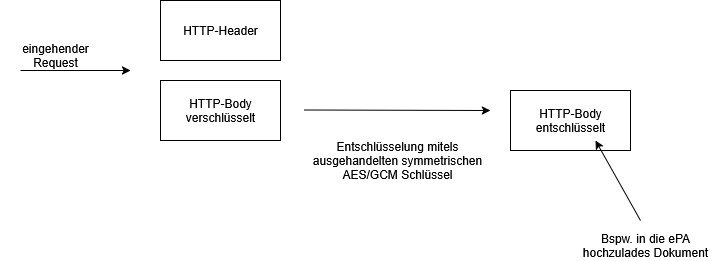
Nur die "Dokumente" (in SOAP-Container eingebettete Objekte) im HTTP-Body wurde verschlüsselt. Da 1-zu-1 Beziehung wurde der HTTP-Body = SOAP-Container = medizinisches Dokument verschlüsselt.

<div drawio-diagram="14"><img src="https://tipkg.de/uploads/images/drawio/2025-07/drawing-1-1753343452.png" alt=""/></div>


#### VAU-Protokoll Version 1.1

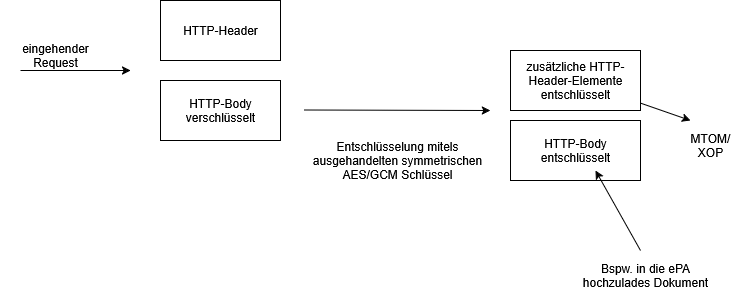
Im Jahr 2019 Erkenntnis: bei bestimmen SOAP-Kodierungen (<span style="box-sizing: border-box; color: rgb(33, 37, 41); font-family: Arial, Helvetica, sans-serif; font-style: normal; font-variant-ligatures: normal; font-variant-caps: normal; font-weight: 400; letter-spacing: normal; orphans: 2; text-align: start; text-indent: 0px; text-transform: none; widows: 2; word-spacing: 0px; -webkit-text-stroke-width: 0px; white-space: normal; background-color: rgb(255, 255, 255); text-decoration-thickness: initial; text-decoration-style: initial; text-decoration-color: initial; font-size: 10pt; line-height: 1.5;">„SOAP Message Transmission Optimization Mechanism (MTOM)“/</span><span style="color: rgb(33, 37, 41); font-family: Arial, Helvetica, sans-serif; font-size: 14px; font-style: normal; font-variant-ligatures: normal; font-variant-caps: normal; font-weight: 400; letter-spacing: normal; orphans: 2; text-align: start; text-indent: 0px; text-transform: none; widows: 2; word-spacing: 0px; -webkit-text-stroke-width: 0px; white-space: normal; background-color: rgb(255, 255, 255); text-decoration-thickness: initial; text-decoration-style: initial; text-decoration-color: initial; display: inline !important; float: none;"> „</span><span style="box-sizing: border-box; color: rgb(33, 37, 41); font-family: Arial, Helvetica, sans-serif; font-style: normal; font-variant-ligatures: normal; font-variant-caps: normal; font-weight: 400; letter-spacing: normal; orphans: 2; text-align: start; text-indent: 0px; text-transform: none; widows: 2; word-spacing: 0px; -webkit-text-stroke-width: 0px; white-space: normal; background-color: rgb(255, 255, 255); text-decoration-thickness: initial; text-decoration-style: initial; text-decoration-color: initial; font-size: 10pt; line-height: 1.5;">XML-binary Optimized Packaging (XOP)“-Kodierung) </span>findet eine (aus Sicht VAU-Protokoll 1.0) ungünstige Verknüpfung zwischen HTTP-Body und HTTP-Header statt. Deshalb mussten nun auch Teile des HTTP-Headers in die Sicherung durch das VAU-Protokoll inkludiert werden.

<div drawio-diagram="15"><img src="https://tipkg.de/uploads/images/drawio/2025-07/drawing-1-1753343567.png" alt=""/></div>

#### VAU-Protokoll Version für ePA für alle 

Im Jahr 2023, Notwendigkeit der Änderung:

- Änderung der Authentisierungsmethode (OAuth2/OIDC)
- PQC-Sicherheit mit einbringen

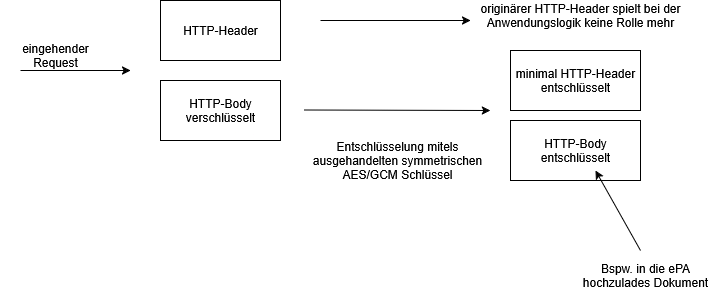
Mit den Erfahrungen der Notwendigkeit der Anpassung von Version 1.0 nach 1.1 wird nun komplett ein minimaler HTTP-Header mit inkludiert. Es gibt also eine vollständigen HTTP-konformen inneren HTTP-Request / -Response.
<div drawio-diagram="16"><img src="https://tipkg.de/uploads/images/drawio/2025-07/drawing-1-1753343707.png" alt=""/></div>